
Employment Services: The Eras Tour
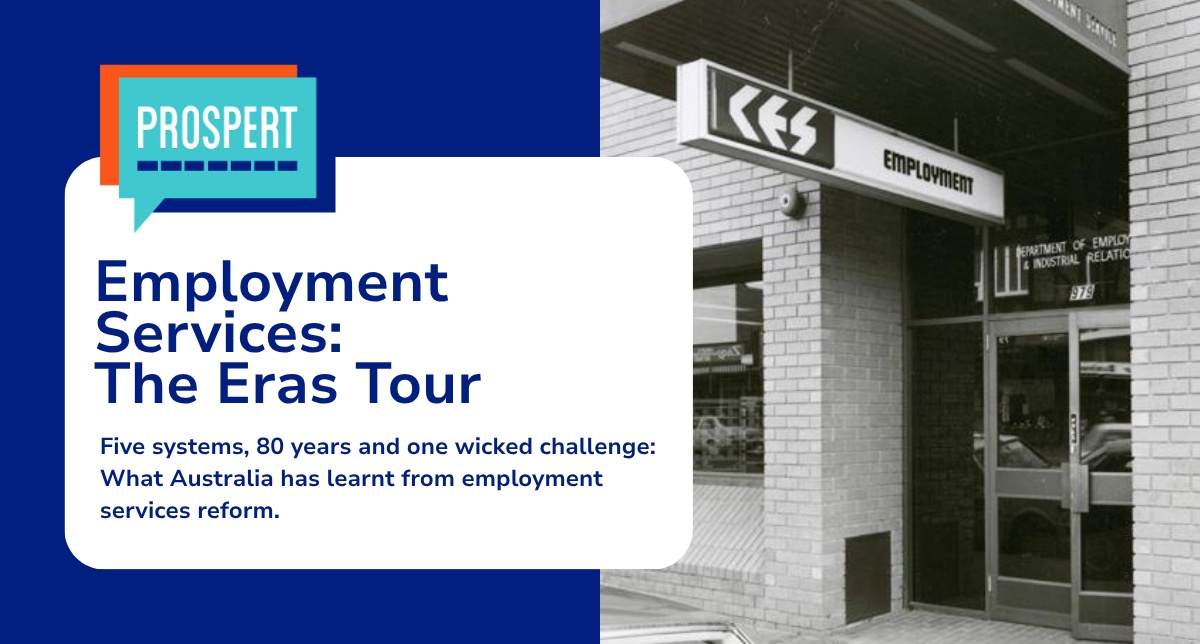
Image Credit: National Archives of Australia
Five systems, 80 years and one wicked challenge: what Australia has learnt from employment services reform.
If Taylor Swift can have an Eras Tour, employment services probably deserves one too.
Over the past 80 years, Australia has moved through public delivery, competitive markets, outcome-based payments, streamed services, stronger mutual obligations, greater provider flexibility and digital self-service.
Now the Federal Government is preparing what it has described as the biggest reform of employment services in 30 years.
But while the scale of the proposed change matters, history reminds us that reform is nothing new. Since the Commonwealth Employment Service (CES) was established in 1946, successive Australian governments have repeatedly redesigned how they help people find work.
Each era has tried to solve the problems of the one before it. Some ideas worked. Some had unintended consequences. And some of the ideas being proposed in 2026 may sound surprisingly familiar, particularly for anyone with extensive experience working in the sector.
So, before we look at where employment services are heading next, Prospert is taking a tour through the eras to ask: how did we get here, what have we learnt, and what should we take into the next one?
Era One: 1946-1998 | the Commonwealth Employment Service
For more than 50 years, the Commonwealth Employment Service (CES) was Australia’s national government-run employment service.
Established in 1946 under the Chifley Labor Government, the CES emerged from Australia's post-war reconstruction effort. It helped unemployed people find jobs and employers find workers, while providing job matching, career advice, referrals to training and other employment assistance.
Importantly, the CES was also highly visible in local communities. Its familiar offices could be found across capital cities, suburbs and regional and country towns, giving jobseekers and employers somewhere local to walk into, speak to a person and get help. By 1988, the CES was handling a record 41 per cent of advertised vacancies.
But the CES wasn’t the whole story.
The government also funded specialist employment and training programs for people who needed more support. Programs such as the Community Youth Support Scheme (CYSS) used youth work, mentoring and community-based approaches to support young unemployed people. CYSS was later rolled into SkillShare, which expanded community-based employment and training assistance to a broader group of unemployed people.
Many of these early programs were delivered through community and not-for-profit organisations and drew heavily on case management, relationship building and holistic support. Some of that language may sound familiar today.
By the late 1980s and early 1990s, rising long-term unemployment was also changing the mainstream system. The Hawke and Keating Labor Governments introduced more active labour-market policies and increasingly differentiated assistance according to need.
The shift towards contracting also began before the CES disappeared.
Under the Keating Government, the Working Nation reforms introduced contracted individual case management alongside public provision. The Employment Services Regulatory Authority oversaw a model in which not-for-profit organisations, and for the first time for-profit providers, delivered a substantial share of intensive case management, alongside the government provider Employment Assistance Australia.
After the Howard Coalition Government was elected in 1996, that experiment was taken further.
Lesson #1: The need to tailor support is not new. Even within the CES era, specialist programs emerged because some jobseekers needed more than mainstream job matching.
Era Two: 1998–2009 | Job Network
In 1998, the Howard Government replaced the CES with Job Network, completing the shift towards a competitively contracted employment services market.
Instead of directly delivering most employment services, government became the purchaser, regulator and manager of a competitive employment services market.
Around 300 organisations entered that market, including private companies, not-for-profits, and community organisations. Government did not disappear from service delivery immediately and created Employment National, which competed alongside private and community providers in the first Job Network contract.
At the time, it was a genuinely radical model internationally.
The idea was pretty simple in theory:
Let providers compete
Give people some choice of provider
Pay providers when people achieved employment outcomes
Pay more for people who were harder to assist
Allow competition to encourage innovation and efficiency.
While early evaluations were positive, the model also exposed a problem that would become remarkably consistent. The problem even had its own employment-services vocabulary:
Creaming: concentrating effort on people who were relatively easy to place
Parking: investing little in people considered unlikely to achieve an outcome.
Over time, government responded with more rules and administration to mitigate the risks.
Lesson #2: You can ask providers to invest in harder-to-help participants, but if the funding model rewards quick job outcomes, many providers will prioritise jobseekers most likely to achieve them.
But Job Network wasn’t the whole system either.
Specialist programs continued to sit alongside it for people who needed support beyond mainstream employment assistance.
The Personal Support Programme (PSP) supported people dealing with significant non-vocational barriers such as homelessness, mental illness and substance use. The Job Placement, Employment and Training Programme (JPET) provided specialist pre-employment support for homeless and at-risk young people.
These programs were often delivered through specialist community organisations and were designed to address barriers, stabilise people’s circumstances and help them move towards employment.
Sound a little like Stream 3?
Era Three: 2009-2015 | Job Services Australia
The election of the Rudd Labor Government brought the next major redesign, and in 2009, Job Network became Job Services Australia (JSA).
The provider market contracted from around 300 organisations under Job Network to 141 providers.
However, Labor did not bring employment services back into government.
Instead, it retained the contracted provider market created by the Howard Government and redesigned it, placing greater emphasis on disadvantage, social inclusion and more intensive support for people further from employment.
JSA divided participants into four streams, with progressively greater assistance available as a person's level of disadvantage increased.
The idea of people needing different levels of assistance depending on their distance from the labour market is not new.
But another significant change happened at the same time.
Specialist programs including PSP and JPET were consolidated into JSA, bringing people who had previously received specialist pre-employment support into the generalist streamed model.
In his 2015 research, Prospert’s Employment Services Advisor, Dr George Giuliani, estimated that the consolidation of specialist programs such as PSP and JPET added around 80,000 very disadvantaged jobseekers to the generalist JSA model, without a corresponding shift in the service delivery model, client-to-worker ratios or overall skill level of the workforce.
That raises a question which feels particularly relevant again in 2026: is allocating someone to a higher-needs stream enough if the capability and service around them doesn’t change?
Again, there were positive results, including stronger part-time employment outcomes for long-term unemployed participants.
But the fundamental market architecture remained. The 2023 Parliamentary inquiry concluded that while JSA increased the focus on disadvantage, it retained the core contracted market and outcomes-based funding model inherited from Job Network.
Lesson #3: A stream can tell you something about a person’s barriers, but not everything about their potential. Tailoring still depends on understanding the individual.
Era Four: 2015-2022 | jobactive
Another change of government brought yet another redesign.
The Abbott Government introduced jobactive in 2015, positioning it as a strong “work first” approach.
The provider market contracted again, this time to just 44 organisations operating from around 1,700 sites nationally.
Jobactive placed greater emphasis on:
Employment outcomes
Mutual obligations
Provider performance
Greater flexibility for providers
Reducing red tape
Creating a strong “work-like culture”.
The early evaluation found improved engagement and evidence of better outcomes for the most disadvantaged participants. But the problem of incentives continued to grow, while mutual obligations and compliance contributed to a poor experience for some participants.
Another weakness was becoming increasingly apparent: employers weren’t particularly engaged with the system.
In its final, comprehensive report titled Rebuilding Employment Services, the parliamentary committee highlighted that a staggering 96% of businesses completely bypass the government's multibillion-dollar employment network.
For a system designed to connect people looking for work with businesses looking for workers, that is a significant problem.
Lesson #4: An employment service needs two customers. Jobseekers AND employers.
Era Five: 2022-present | Workforce Australia
Workforce Australia was designed by the Morrison Coalition Government and, ironically, launched (with a few minor changes) under the Albanese Labor Government in 2022.
And it didn’t arrive without a test run.
From 2019, the Morrison Government tested key elements of the future model through the New Employment Services Trial (NEST) in Adelaide South and the Mid North Coast of NSW.
The trial tested digital servicing and enhanced provider services before the model was rolled out nationally.
While the provider market barely changed in size, the service delivery model did. For the first time, job-ready people could self-manage through Workforce Australia Online. People assessed as needing more assistance were referred to provider services.
The broader system continued to rely on specialist programs to support the mainstream service like Transition to Work for young people, Parent Pathways, Career Transition Assistance for people over 45 years and Self-Employment Assistance.
The basic idea underpinning Workforce Australia made sense: people capable of finding work themselves should not have to attend unnecessary provider appointments, freeing provider resources for people who need more help.
But the digital experiment exposed new problems around triage, intervention and personalisation. Questions were asked about who should be in digital services, for how long, and when should someone intervene?
In announcing the latest reforms, Minister for Employment Amanda Rishworth said “around one in five Workforce Australia participants, approximately 140,000 people, had been in the system for five years or more.”
That is despite Australia experiencing historically low unemployment.
Lesson #5: Digital is a channel, not a service model. For people who are job-ready and digitally literate, digital makes sense, but it cannot replace timely human intervention when someone needs support.
Era Six: 2026 onwards | Back to the future?
The Albanese Labor Government is now proposing three distinct service streams:
Stream 1: online and brief intervention for people closer to employment
Stream 2: targeted provider services for people requiring more assistance
Stream 3: intensive services for people facing complex barriers.
But haven't we seen streams before? Yes.
The potentially fundamental difference this time is that the Government says each stream will not simply offer a different level of the same service. Instead, they are intended to have different:
Service models
Levels of support
Provider incentives
Approaches to mutual obligations
Provider capabilities.
The Government is also planning an early rollout of intensive Stream 3 services before introducing the broader system.
Just as NEST tested parts of Workforce Australia before national implementation, this early rollout provides another opportunity to test whether the model works before taking it to scale.
In addition, employers are intended to have a much bigger role in the system.
So, what has 80 years of reform taught us?
For all the changes in governments, program names, contracts and technology, some challenges have been remarkably persistent.
The hardest group to serve has remained the hardest group to serve throughout every iteration of reform.
We know funding incentives shape provider behaviour. Caseloads affect how much time workers can spend with people. Workforce capability matters. Assessment matters. Employer relationships matter. Meaningful participant engagement matters. And specialist support can lose something when it is absorbed into a generalist model without the necessary capability and resources.
Changing the name is the easy part. Changing the incentives, behaviours and relationships underpinning the system is much harder.
As Australia prepares to enter its next employment services era, the challenge will be making sure this is more than another change of set list.
Over the coming months, we’ll unpack the proposed reforms, test what is changing against what we’ve learned before, and share our insights as the new system takes shape.
Because if the Employment Services Eras Tour has taught us anything, it’s this: the detail matters, and providers that understand the direction of reform early will be better placed for what comes next.
Prospert is working with employment services organisations to interpret the reforms, understand the implications and start preparing for the next era.
If you’re thinking about what the reforms could mean for your organisation, now is a good time to start the conversation.