
Building Employer Engagement in the IEA Era
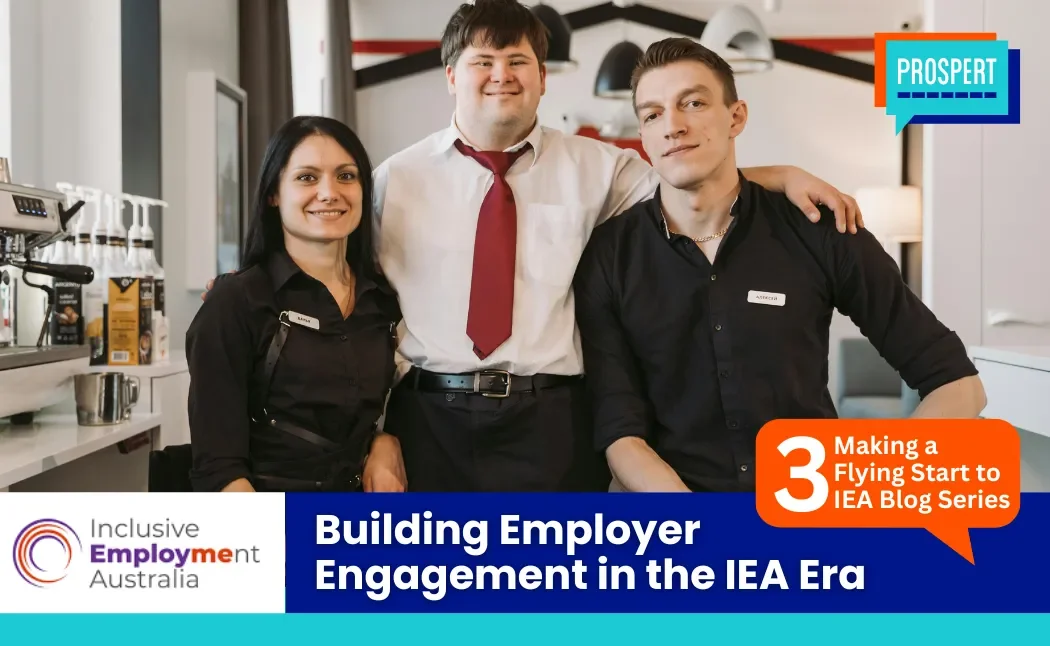
Employer engagement has always been a critical part of disability employment services, but under Inclusive Employment Australia (IEA) it takes on new urgency. In addition, Minister for Social Services, Tanya Plibersek, is particularly interested in doing more work on employer demand.
This was a central theme in Prospert and Disability Employment Australia’s recent webinar, “IEA: Anticipating the Performance Framework and Making a Flying Start.”
Why Employer Engagement Matters More Than Ever
From day one of the new contract, providers will be working with caseloads that include participants who are already job-ready. Delays at this point risk losing momentum and opportunities.
As Paul Diviny, Founder and Director of Prospert, explained: “You want to grab those participants straight away and get them into work. Reverse marketing, job carving, and objection handling are going to be really crucial, especially if you’ve got staff in 360 degree roles where every minute with an employer has to be invested wisely.”
Peter Bacon, CEO of Disability Employment Australia, spoke about the turbulence providers are facing and the need to shift quickly into proactive mode.
“Getting from the point of, frankly, what has been a pretty turbulent process for everyone involved in the industry and getting onto the front foot is going to be critical for organisations,” he says.
For employers, that means not just filling vacancies but ensuring relationships are strong enough to sustain placements. Providers will need to engage employers as genuine partners, supporting them to include and retain participants in meaningful roles.
The Skills Providers Need
To succeed in IEA, providers must ensure their teams are equipped with the right employer engagement skills. These are not optional extras, they are central to sustainable outcomes:
Reverse Marketing – covered in Prospert’s Reverse Marketing micro course, this skill teaches consultants how to actively promote participants to employers, identify hidden opportunities and build trust through tailored pitches.
Job Carving – the Job Carving micro course shows how to create customised roles that align participant strengths with business needs, a win–win for both sides.
Objection Handling – Prospert’s Handling Objections micro course equips consultants with strategies to confidently reframe employer concerns into opportunities for inclusion.
Structuring the Roles
Paul pointed out that different stages of the participant journey require different capabilities:
360 degree consultants need strong time management to balance participant servicing and employer engagement
Dedicated business developers need to focus on building employer pipelines across ESAs
In-employment support specialists need to ensure employers feel supported once participants are placed.
“You don’t want to drop the ball with participants already in work. Providers are putting dedicated roles in place to engage employers and reassure them that in-employment support is here to help,” Paul noted.
Investing in Skills and Learning
Both Peter and Paul emphasised that induction and ongoing development are crucial to maintaining strong and focused teams. Workforce Australia showed what happens when providers don’t invest in training early, staff churn and unfilled roles that weaken outcomes.
Prospert’s suite of micro learning programs is designed with these lessons in mind. Delivered in short, practical modules, the micro learning courses include Reverse Marketing, In-Employment Support, Handling Objections, Job Carving and Community Engagement. Each course runs for 1.5 hours online and helps frontline staff embed employer engagement skills quickly and confidently.
For those needing deeper capability, Prospert also offers the comprehensive Effective Employer Engagement program, which includes online modules, live learning and mentoring. In addition, the Leading Employer Engagement program is also delivered in a blended format, focusing on equipping leaders to coach, support and embed best practices across teams. Both programs are recognised by DEA, with participants earning 40CPD points toward professional membership.
As Paul noted during the webinar: “Providers who recognise the need to skill their staff in employer engagement will have the edge. These skills are not just about filling jobs, they’re about creating long-term, sustainable outcomes for participants and employers.”
Prospert’s Take
Employer engagement under IEA is about more than “selling” participants, it’s about building trusted partnerships that support sustainable outcomes. Providers who invest in role structures and professional learning will stand out in a competitive market. Contact Prospert today to discuss your organisation’s learning needs.
In the next blog, we’ll turn to data and business intelligence – the tools every provider needs at their fingertips to stay ahead under IEA.