
Why Relational Engagement Matters Now
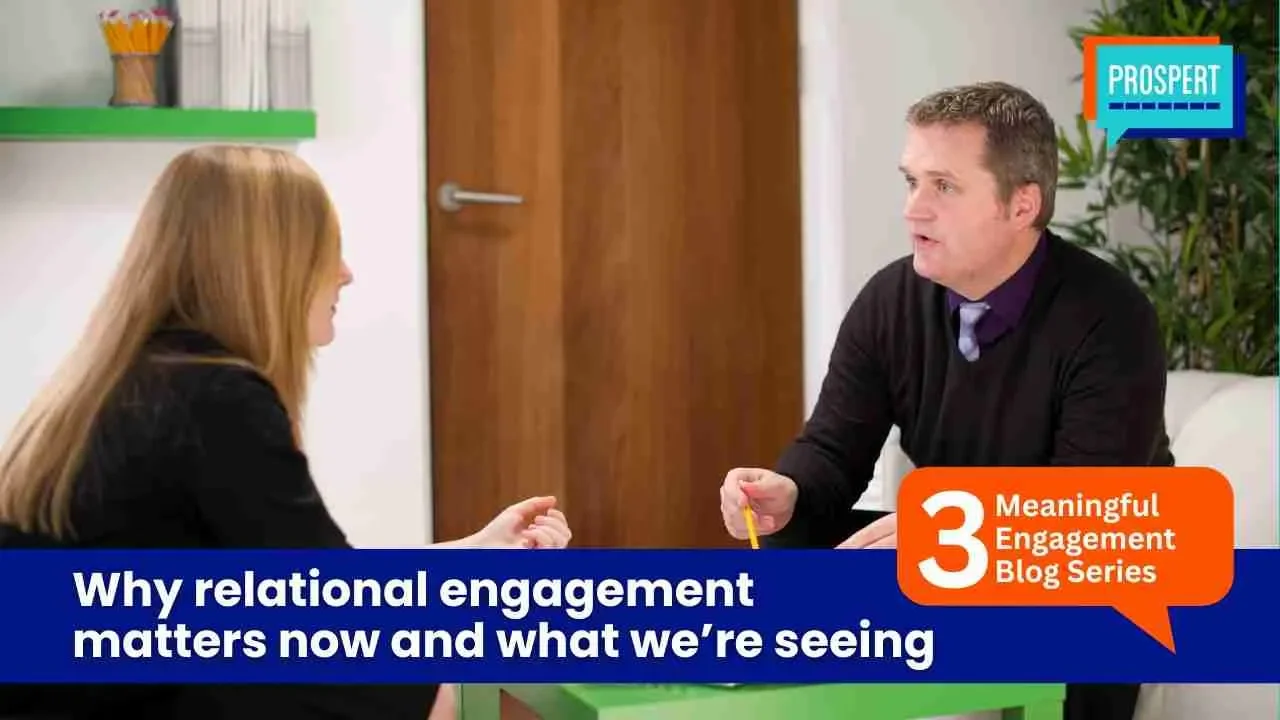
Relational engagement is not a new idea in employment services. But across many services globally, it is gaining renewed attention.
Governments, policymakers and providers are placing greater emphasis on participant experience, long-term outcomes and sustainable employment. At the same time, performance frameworks are evolving to reflect these priorities.
Disability Employment Australia’s CEO, Peter Bacon, says most providers have long focused on a more relational, person-centred approach.
“The shift to a focus on relationships is largely bringing good practice and regulatory arrangements into alignment,” says Peter.
A changing performance environment
Under the new Inclusive Employment Australia performance framework, participant experience will account for 30 per cent of provider performance, alongside employment outcomes weighted at 70 per cent. Participant satisfaction and capability building surveys will also introduce a direct participant voice into provider ratings.
For the first time, participants’ experiences with services will directly influence provider performance. The framework also places greater emphasis on long-term employment sustainment, including 12, 26 and 52 week outcomes. Together, these changes reinforce the importance of meaningful engagement, not just initial placement.
For providers, this represents a significant shift. Engagement quality is no longer just a practice issue. It is becoming a performance driver.
What providers are experiencing
Across providers, similar patterns are emerging.
Frontline staff are balancing participant engagement with compliance, documentation and performance requirements. Participants are engaging with services, but not always with shared clarity around goals, roles or next steps. Engagement challenges are often framed as motivation or readiness issues, while staff manage increasing pressure from caseloads and performance expectations.
As a result, engagement quality is becoming a delivery risk.
When engagement lacks structure, consistent participation and progress can break down. Consultant effort increases, outcomes become less consistent and responsibility for maintaining momentum often rests with individual staff judgement. Over time, this can affect both performance and staff wellbeing.
A structured approach to relational engagement
Prospert facilitator and researcher Dr George Giuliani describes relational engagement as a professional capability that can be developed and strengthened, rather than something that relies on individual style or experience alone.
This approach underpins Prospert’s Meaningful Participant Engagement program, which provides a structured framework for building purposeful engagement, developing clear task agreements and aligning around shared goals. The model also focuses on maintaining engagement over time, particularly when challenges arise or participants disengage.
Rather than replacing existing case management processes, the Meaningful Participant Engagement approach strengthens how consultants work within current systems. It provides practical tools and structure to support consistent engagement, while still working within contract requirements and operational processes.
Why providers are investing in engagement capability
As performance expectations evolve, providers are increasingly investing in engagement capability across frontline teams. Prospert’s Founder and Director, Paul Diviny, says the shift is about building consistent, sustainable practice.
“Engagement quality is becoming critical to performance,” he says.
“Providers are looking for ways to support consultants to work consistently, particularly with more complex participants.”
The Meaningful Participant Engagement workshop focuses on practical application, including real-world scenarios, structured role play and guided practice using live caseload examples. This helps consultants build confidence in managing disengagement, revisiting goals and having difficult conversations.
George says many consultants entered the sector during compliance-focused periods and may not have developed relational engagement skills.
“A lot of people who came into the sector more recently haven’t necessarily had to work this way. Some naturally do it, but others haven’t had the opportunity to build those skills.”
He says research across social services consistently highlights the importance of strong working relationships.
“When people feel connected to the person supporting them, they tend to get better results,” he says.
A global conversation
Paul says providers internationally are facing similar challenges.
“We’re hearing similar conversations globally where there’s a growing interest in participant experience, sustainable outcomes and more personalised engagement,” he says.
Recent discussions in Canada and New Zealand suggest providers are increasingly focused on how to build stronger engagement and support consultants to work differently.
These conversations reflect broader trends in human services, where co-production and participant-centred approaches are becoming more common.
Early results
Given these broader trends, Prospert has worked with Dr George Giuliani to create a program that equips employment consultants with new capabilities to engage disadvantaged cohorts across all programs, not just Inclusive Employment Australia.
Prospert’s Meaningful Participant Engagement workshops have already been delivered to more than 80 frontline consultants, with feedback highlighting improved confidence, stronger relationships and practical application in day-to-day work.
Feedback from learners includes: “It was so relevant to all that we do in our day-to-day roles. I took a lot out of it in terms of how I can assist and build relationships” and “The de-escalation of disengaged participants was very useful. As a new starter, I found all the tips and techniques to be very relevant”.
Participants reported that role plays, real-world examples and structured frameworks helped them manage disengagement and build stronger participant relationships.
A growing priority
As employment services evolve, relational engagement is becoming central to better job outcomes. Providers who strengthen relational engagement capability will see improvements in:
Participant retention
Employment sustainment
Participant experience
Staff confidence and job satisfaction
As performance frameworks evolve and expectations shift, relational engagement is becoming more than a practice preference. It is increasingly central to how employment services are delivered.
For many providers, the focus is now on building the capability to support it.
Contact Prospert to learn more about the Meaningful Participant Engagement workshop and how it can support your frontline teams.